Trials

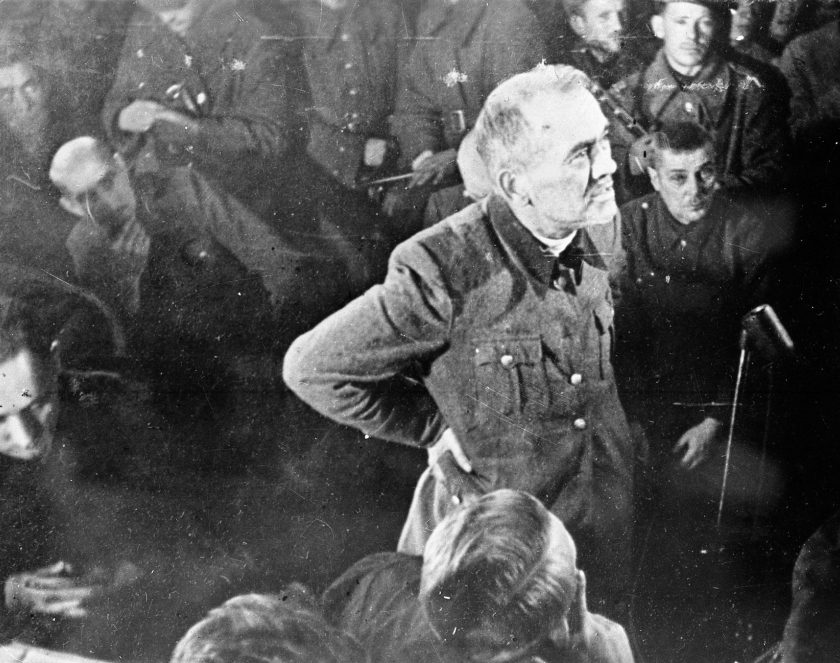
An elderly man in a German uniform is standing amongst other men. He has his hands on his hips and says
The first trials of the Majdanek garrison members were held by the Third Reich at the time when the camp was still fully operational. The SS and police courts of various instances were trying several members of the KL Lublin staff, including two of its former commandants – Karl Otto Koch and Hermann Florstedt. They were charged with multiple cases of embezzlement the state property of the Third Reich, particularly for stealing the possessions plundered from the prisoners of Majdanek. They were both sentenced to death.

The First Majdanek Trial

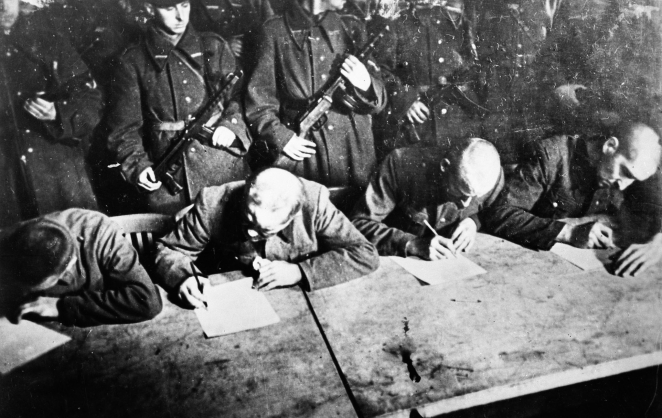
While it was the downfall of the Third Reich that paved the way for seeking justice for the mass murder crimes committed at Majdanek, the Polish judiciary first faced this challenge even earlier. The special court in Lublin presided at the turn of November and December 1944, building a case against SS-men: Wilhelm Gerstenmeier, Theodor Schöllen, Anton Ternes, Hermann Vogel; and two German kapos: Heinz Stalp and Edmund Pohlmann (who committed suicide in his prison cell on 29 November). On 2 December 1944 the remaining defendants were sentenced to death by hanging. They were executed on the former camp grounds, with huge crowds of spectators gathered around the crematorium building.

Four men are sitting at a table. They are holding pens and leaning over sheets of paper. Behind them stands a row of uniformed men, weapons in hand
Convicts from the first Majdanek trial are writing letters requesting pardons.

Trials held in the years 1946-1948

Similar trials were held by Polish courts in the years 1946-1948. A total of 95 former Majdanek garrison members were tried, including Elsa Ehrich who was sentenced to death and executed on 26 October 1948. At the same time proceedings were held with regards to crimes committed in other concentration camps, during which the SS-men from Majdanek were also sentenced. For example, the Supreme National Tribunal in Kraków tried perpetrators in the First Auschwitz Trial in late 1947. Among them there were important members of Majdanek garrison: Erich Mußfeld who was in charge of the crematoria, the last camp commandant Arthur Liebehenschel (both sentenced to death), as well as Karl Seufert and three female overseers: Luise Danz, Hildegard Lächert, and Alice Orlowsky, who were sentenced to prison.

Düsseldorf Trial

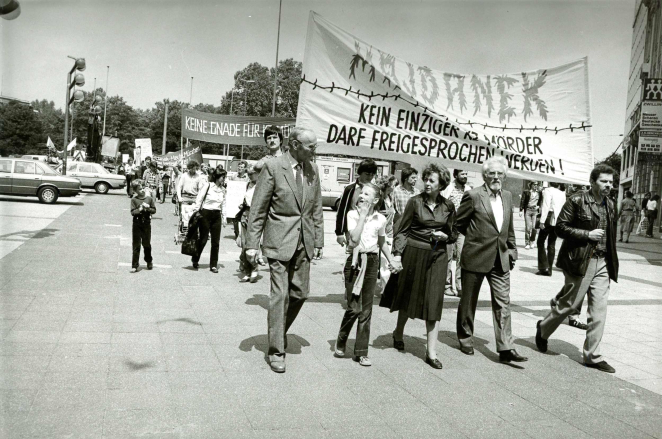
The longest trial of 17 Majdanek garrison members was held by the court in Düsseldorf. It lasted from 26 November 1975 to 30 June 1981. Four defendants were revoked from the proceedings due to their deaths or poor health, five more were acquitted. Eight persons charged with murder, or complicity in murder were proclaimed guilty. One of them was sentenced to life imprisonment, seven to imprisonment for three to twelve years. The court verdict was widely criticised by the prosecution, politicians, and the public.

A group of people are walking down the street, holding a banner with a message in German.
Protesters demanding justice for Nazi crimes gathered during the Düsseldorf trial. Danuta Brzosko-Mędryk, a survivor of Majdanek, is visible in the centre.

Karl Höcker Trial

The last sentence ruled with regards to crimes committed in KL Lublin was announced during the trial of Karl Friedrich Höcker, who was the adjutant of Majdanek commandants Florstedt and Weiß. On 3 May 1989, the district court in Bielefeld sentenced him to four years of imprisonment for complicity in the mass murder of Jews in the gas chambers.