Brief Outline

Rows of barracks seen from a bird's eye view
The German Nazi concentration camp in Lublin, commonly known as Majdanek, was established by order of the Reichsführer-SS Heinrich Himmler. During his visit to Lublin in July 1941, he ordered the creation of a camp for “25,000-50,000 prisoners, to be used in the workshops and construction sites of the SS and police”. Those prisoners were to become a slave labour force for establishing the new German empire in the east. This task was entrusted to the commander of the SS and police forces in the Lublin district Odilo Globocnik.

Camp Construction

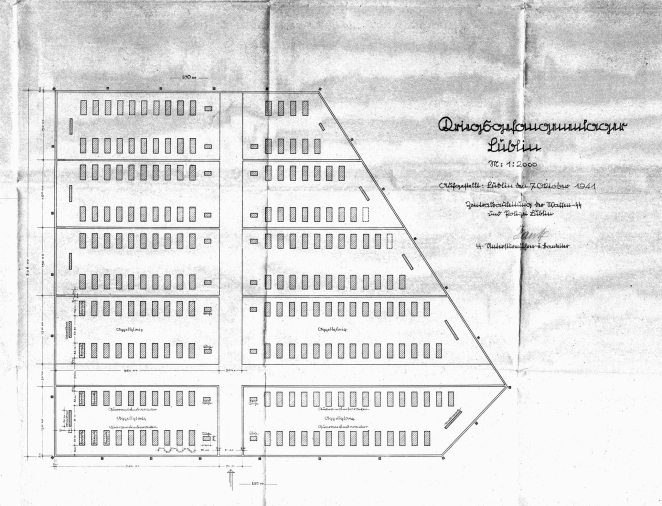
The initial assumptions for the shape of the camp were repeatedly modified, increasing its size and the number of prisoners. The so-called general construction plan of Majdanek, which was approved on 23 March 1942, assumed the creation of a camp for 150,000 inmates. Therefore, following those provisions KL Lublin was to become the largest camp in the German-occupied Europe. Economic obstacles and progressive defeats of Germany on the eastern front brought the implementation of that plan to a halt. Eventually the camp took the form in which it had the capability of keeping 25,000 prisoners.

A document in German with rows of rectangles drawn on it, symbolizing barracks
First camp construction plan from 7 October 1941.
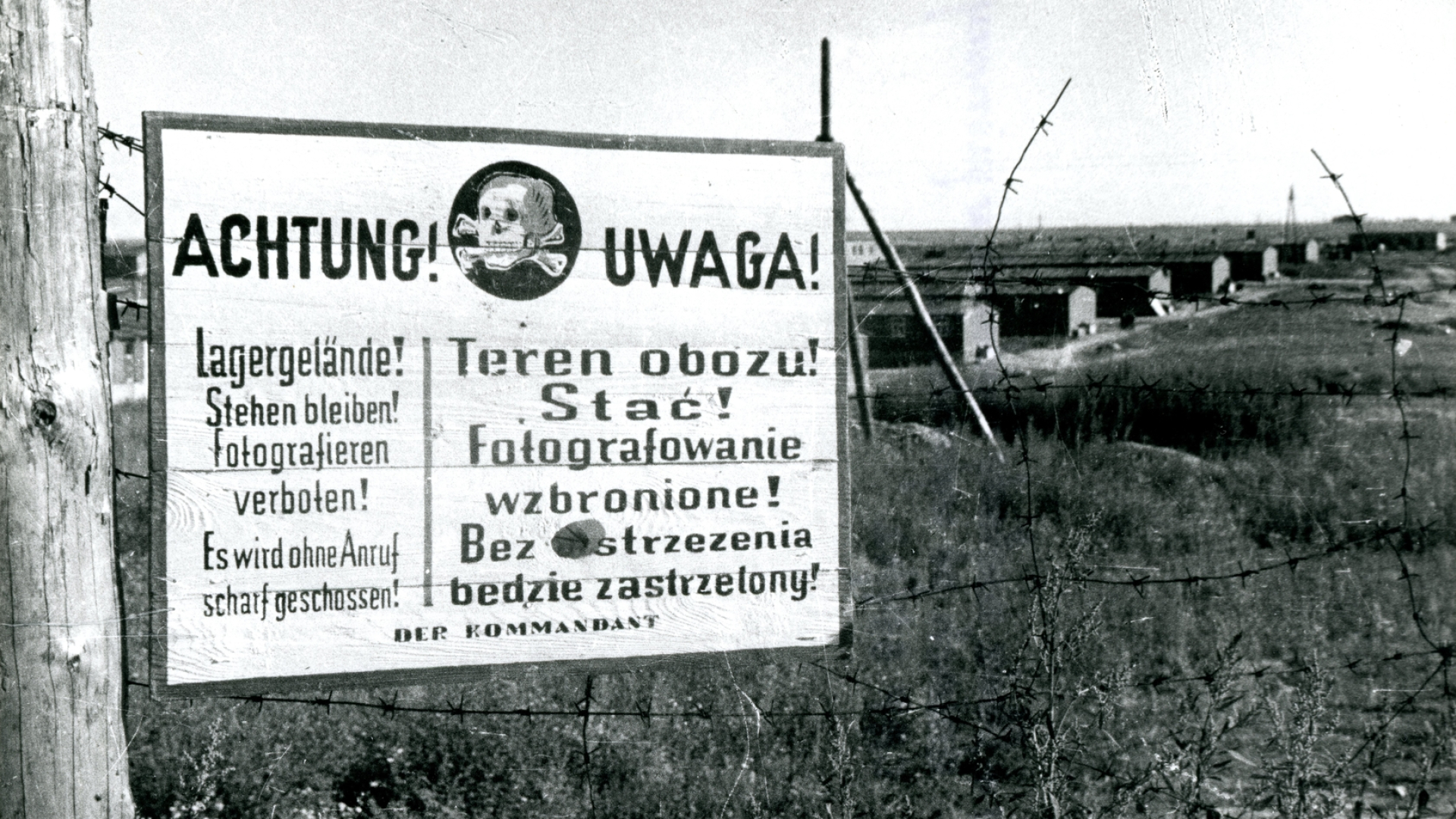
A black-and-white photograph showing, in the foreground, a white sign in Polish and German bearing the symbol of a skull and two crossed bones, set against a row of wooden prison barracks
Former camp grounds, summer 1944.

SS Camp Administration

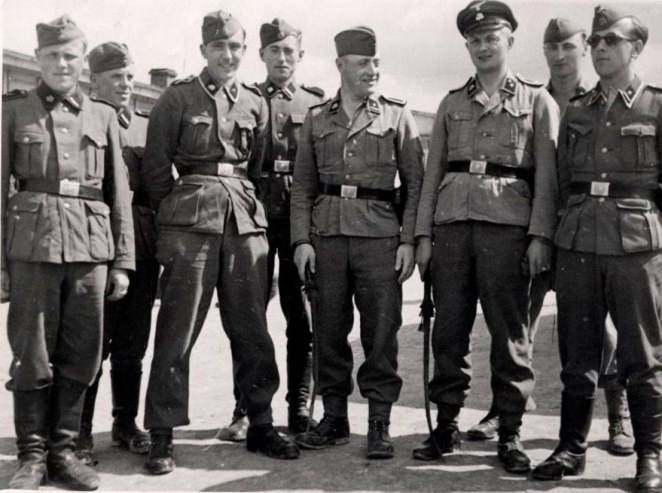
KL Lublin was subordinate to the Inspectorate of Concentration Camp (Inspektion der Konzentrationslager), which was transformed into Department D of the SS Main Economic and Administrative Office (SS-Wirtschafts- und Verwaltungshauptamt). The camp was managed by its commandant and the garrison of over 1,200 members. The commandant position was held subsequently by Karl Otto Koch, Max Koegel, Hermann Florstedt, Martin Weiß i Arthur Liebehenschel.

Eight men standing side by side wearing German uniforms and caps
SS-men at the Majdanek concentration camp, spring 1942.

Camp Functions

The camp construction began in the autumn of 1941. Initially it was named Kriegsgefangenenlager der Waffen-SS Lublin (camp for prisoners of war) and then it was renamed to Konzentrationslager Lublin (concentration camp) in February 1943. The official functions of Majdanek as a POW and concentration camp did not exhaust its actual role in the Nazi policies. It also served as a penal-transit camp for Polish rural population and a transit camp for people displaced from Belarus. KL Lublin was also an important part of the “Final solution to the Jewish question”.

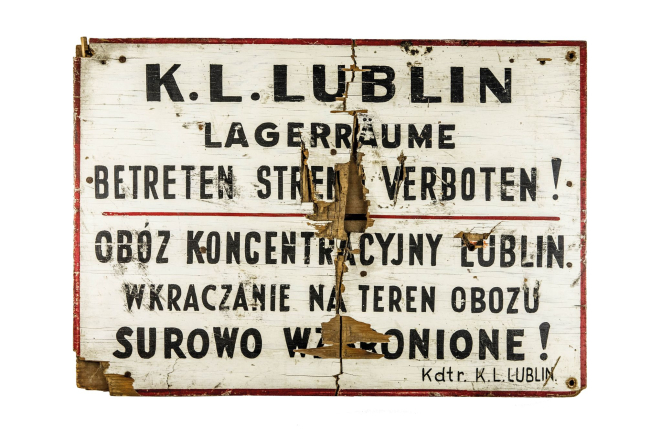
Biała metalowa tablica z napisem w języku polskim i niemieckim o treści: Obóz koncentracyjny Lublin. Wkraczanie na teren obozu surowo wzbronione!
Board with the official name of Majdanek as a concentration camp.

Topography and Living Conditions

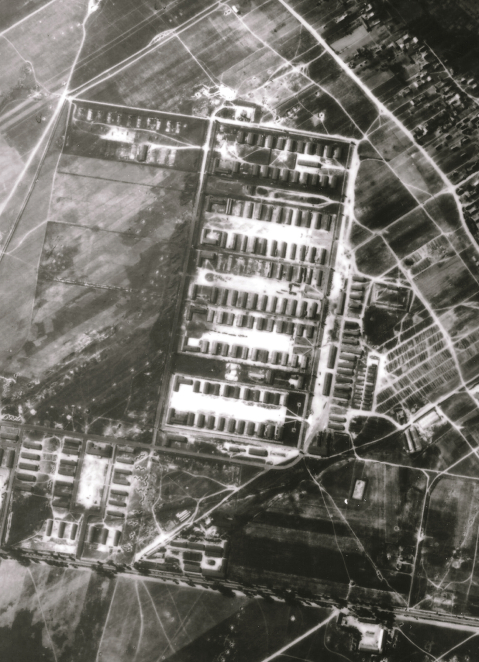
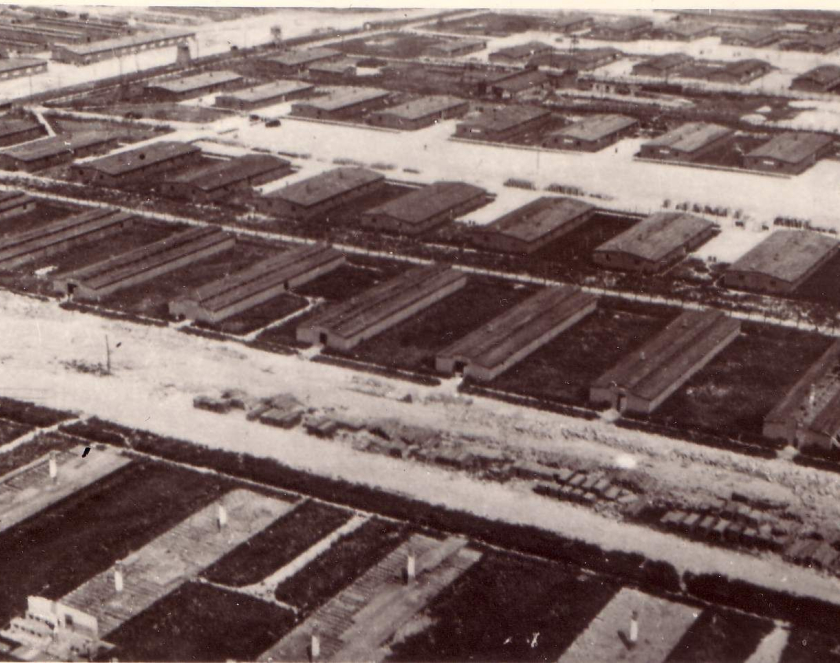
The Germans established the camp on the south-eastern outskirts of Lublin, next to the road leading from the city to Zamość and Lviv. The compound covered 200 hectares (ca. 667 acres) and comprised of three main parts: the SS sector, the economic sector, and the prisoner camp (Schutzhaftlager) that included five prisoner fields. There, primitive wooden barracks were erected, which were usually overcrowded and lacking even the basic sanitary facilities. The awful living conditions were additionally hampered by the extremely restricted access to water, food, clothes, and medicines. Those factors result with a rapid spread of diseases and high mortality rate among the inmates. Only towards the end of its functioning did the conditions slightly improve in KL Lublin.

Aerial photograph, concentration camp grounds at Majdanek in 1944; rows of barracks and patches of trampled earth, surrounded by farmland
Aerial photograph of the former Majdanek camp grounds taken by the Luftwaffe in September 1944.

Prisoners and their Fates

Majdanek functioned between October 1941 and July 1944. Initially, only men were detained there, including Polish political prisoners from January 1943. Women’s camp operated from October 1942 at one of the prisoner fields. Although a planned separate section for children was never created at Majdanek, Jewish, Polish, and Belarusian kids were also imprisoned there. A lazaret for Soviet invalids functioned from May 1943. Majdanek additionally had five sub-camps: in Bliżyn, Budzyń, Radom, in Lublin’s Lipowa Street, and KL Warschau.


Prisoners came from around thirty countries. Most of them were the citizens of Poland, the Soviet Union, and Czechoslovakia. The most numerous groups – after Jews and Poles – were Belarusians, Russians, and Ukrainians. Other nationalities (e.g. Germans and French) were also present though they represented a minority.

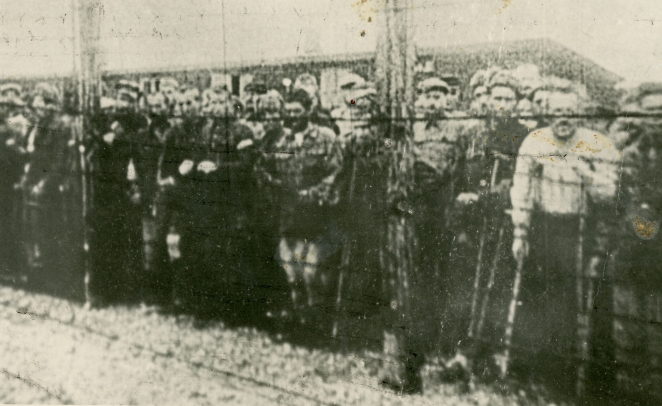
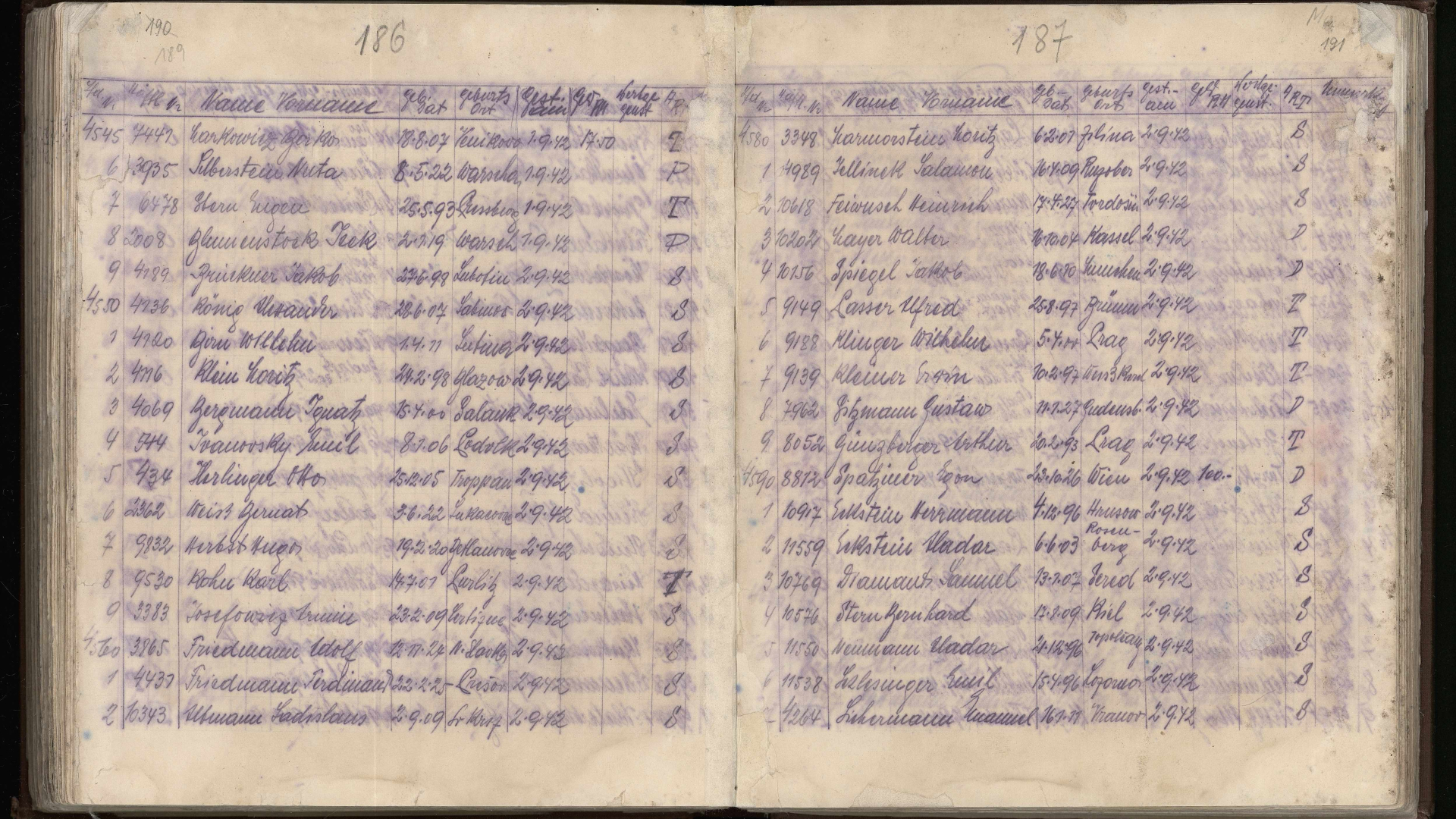
From the first moments of their presence in the camp, the prisoners were exposed to hunger, fear, diseases, and exhausting labour. Any actual or merely alleged violations of in-camp regulations were punishable with severe beatings and harassments. Their lives were in constant danger. The prisoners lost their lives due to horrible living conditions, and were murdered during executions and in the gas chambers. According to our latest research, approximately 80,000 prisoners from among the total of 130,000 people deported to Majdanek perished in the camp. The largest groups of the victims included Jews (ca. 60,000), Poles, Belarusians, Russians, and Ukrainians. Bodies were burned in the open-air pits and crematorium ovens to conceal the crime.

A barbed wire fence, behind which dozens of men are crowded together. In the background, a single-story wooden prison barracks.
Soviet POWs at Majdanek, 1944.
Pages written in blue ink.

KL Lublin Liquidation

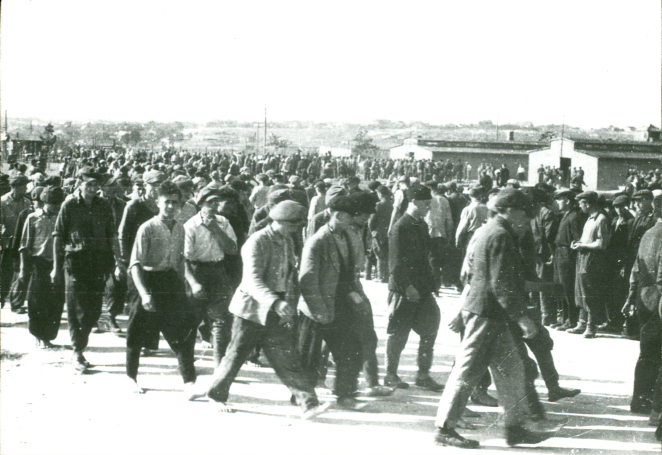
The tragic history of the German Nazi concentration camp in Lublin ended on 22 July 1944, when the SS garrison abandoned the camp taking nearly all the remaining prisoners to Auschwitz. The Red Army entered its grounds on 24 July, and soon used the camp infrastructure for their own needs. At Majdanek, the Soviets established an NKVD camp to imprison soldiers of the Polish Underground. Some areas at Majdanek were also temporarily used to detain German POWs.

In the foreground, a group of several young men walking. In the background, two barracks and a group of several dozen men.
Conscription to the 1st Polish Army held at the former prisoner field III of Majdanek. The barracks and prisoners of the NKVD camp are visible in the background.