Józef Richter

Rediscovered

Józef Richter

The story of Józef Richter has for years remained forgotten, even though he created numerous drawings depicting the persecution and extermination of Jews in the Lublin region during World War II. The State Museum at Majdanek brought him back form oblivion through a special temporary exhibition presented in 2017. While many things surrounding his fate remain unknown, certain learning and discoveries have been recently achieved.

Drawings on the Scraps of Life

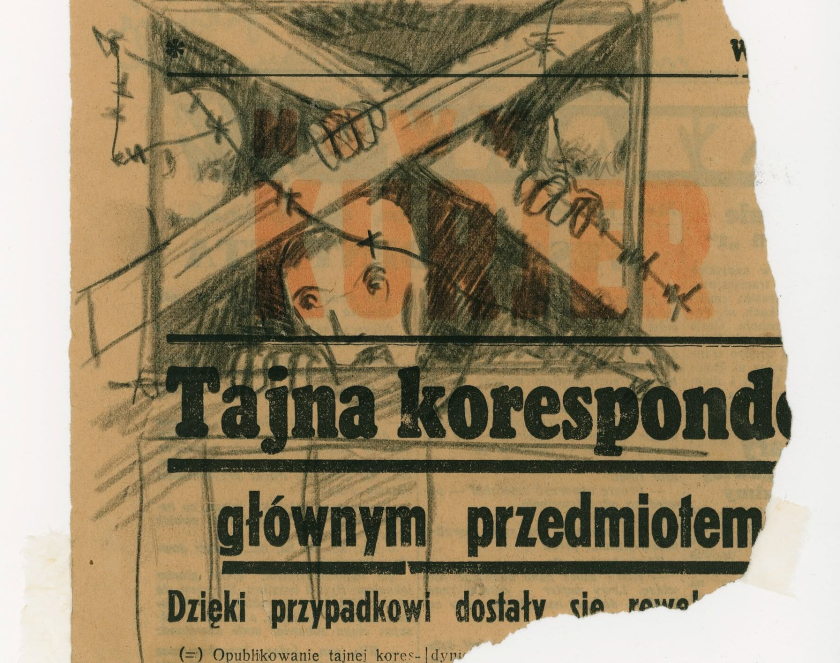
That exhibition, prepared by Krzysztof Banach and Lech Remiszewski, included 18 drawings preserved in the collections of the Ghetto Fighters’ House Museum in Israel. Sketches illustrate the crimes perpetrated by the Germans against Jews in the years 1942-1944. As a witness to these events, the artist applied his  great sensitivity and meticulous care to capture scenes from the functioning of the labour camps in Trawniki and Lublin, the Majdanek concentration camp, the Sobibór extermination camp, as well as ghettos and sites of mass executions, recording them on scraps of newspapers and occupation-era notices.
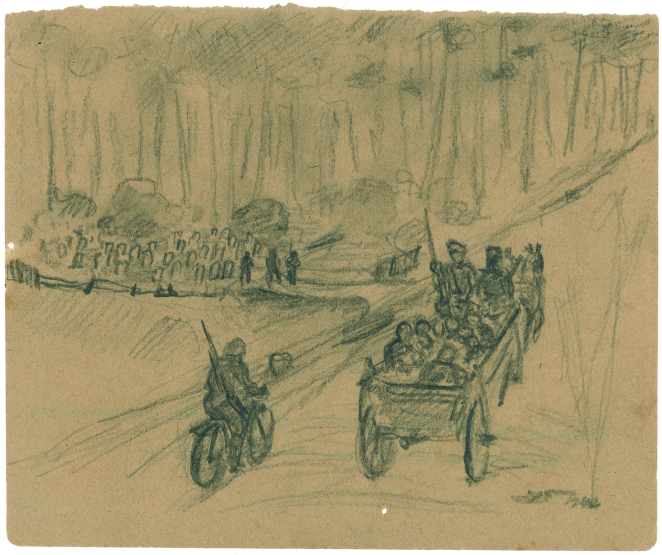
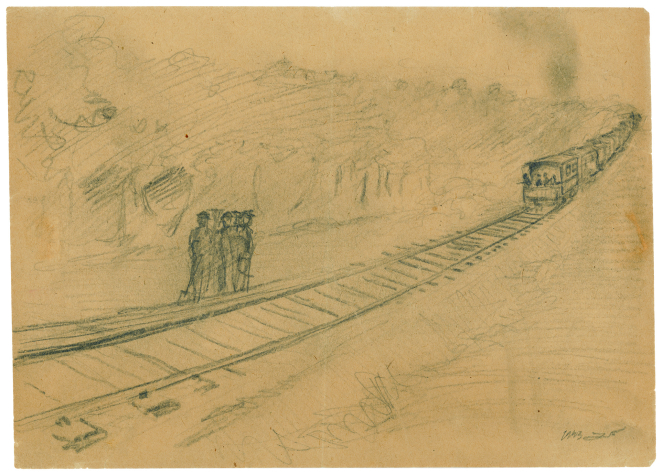
Owing to its form, this is a unique, yet at the same time extremely interesting and important testimony to the persecution and extermination of the Jewish population, created at the very moment when the Germans were carrying out their criminal plan for the extermination of Jews, which was codenamed ‘Einsatz Reinhardt’ within the General Government (GG). The specific nature of the material on which the sketches were made determined the title of the exhibition: Drawings on the Scraps of Life.

Richter’s Identity

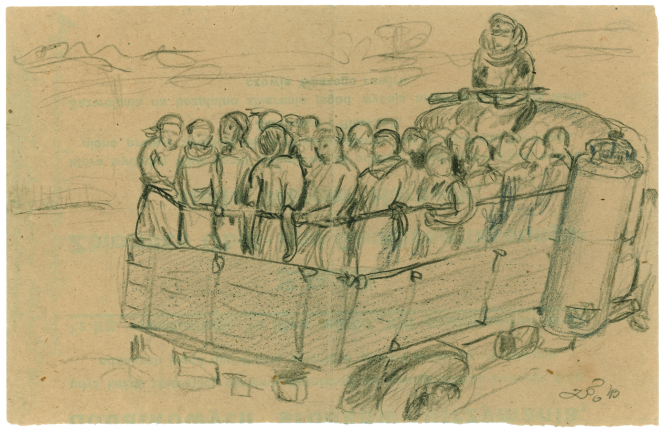
Whilst gathering material for the exhibition, the organisers wondered who Richter was, what he looked like, where he came from, what he did for a living, and what his experiences were during the occupation. The exhibition catalogue states: “There are many theories regarding the identity of Józef Richter. From the content of his drawings, we learn that during the occupation he may have been employed as a railway labourer on the modernisation of the Dorohusk–Chełm–Lublin line. He most likely came from the Chełm area. It is possible that he belonged to the so-called Baudienst – the German Construction Service which forcibly employed Poles.” It is also known that one of the drawings is a self-portrait of the artist, who, standing with a group of labourers, is watching a transport of Jews being brought to Sobibór. Much of the information, which was initially merely a hypothesis, has been confirmed over time, though chance played a significant role in this.

Aleksander Paszko’s Account

Whilst compiling sources for an article on Jewish prisoners at the Majdanek concentration camp, I came across an account by a Polish man, Aleksander Paszko, which he gave in June 1967 whilst in Israel. Aleksander, also known as Aleksy Paszko, was born on 5 July 1912 in Kraśniczyn in the Krasnystaw district, where he also remained during the occupation; after the war, he settled in Piaski near Lublin. He was a dental technician by profession.

This testimony proved to be an extremely important source for research into Richter’s fate during the occupation. According to the account, it was Paszko and his wife Leonarda who, between 1942 and 1944, provided assistance to Richter, whose surname is recorded as ‘Rychter’ in the aforementioned memoirs; I shall use this spelling in the remainder of this article.

The Paszko Family Shelters Jews

The Paszkos’ stance forms part of a wider debate that has been ongoing in Poland for many years, and which has recently gained momentum; it concerns the attitudes of Poles towards Jews during the German occupation. The behaviour of sections of Polish society varied greatly: on the one hand, there was selfless help; on the other, there were instances of people being handed over to the German authorities and the murder of those seeking refuge. Between these two extremes lie behaviours characterised by many shades of grey. Unfortunately, indifference was also widespread. Many Poles were afraid to help Jews, as doing so carried the threat of the death penalty. In this context, it is worth paying particular attention to the words of Henryk Grynberg, a survivor of the Holocaust: ‘It was enough simply not to inform on them, not to hand them over, not to betray them, not to blackmail them, not to rob them and – as God commanded – thou shall not kill.’

Richter was not the only person to receive support from the Paszko family. As early as 1940, he was involved in smuggling Regina Gladberg out of the General Government into the Soviet occupation zone, enabling her to reach Lutsk, where her husband was staying. The fugitive’s subsequent wartime fate proved tragic, as she lost her husband and child, whilst she herself was exiled to Siberia. After the war ended, she returned to Poland as part of the repatriation programme and settled in Szczecin, from where she emigrated to Israel. In the autumn of 1942, Paszko also smuggled Stella Fast out of the Warsaw Ghetto to the ‘Aryan’ side. She survived the occupation, but they lost contact after the war.

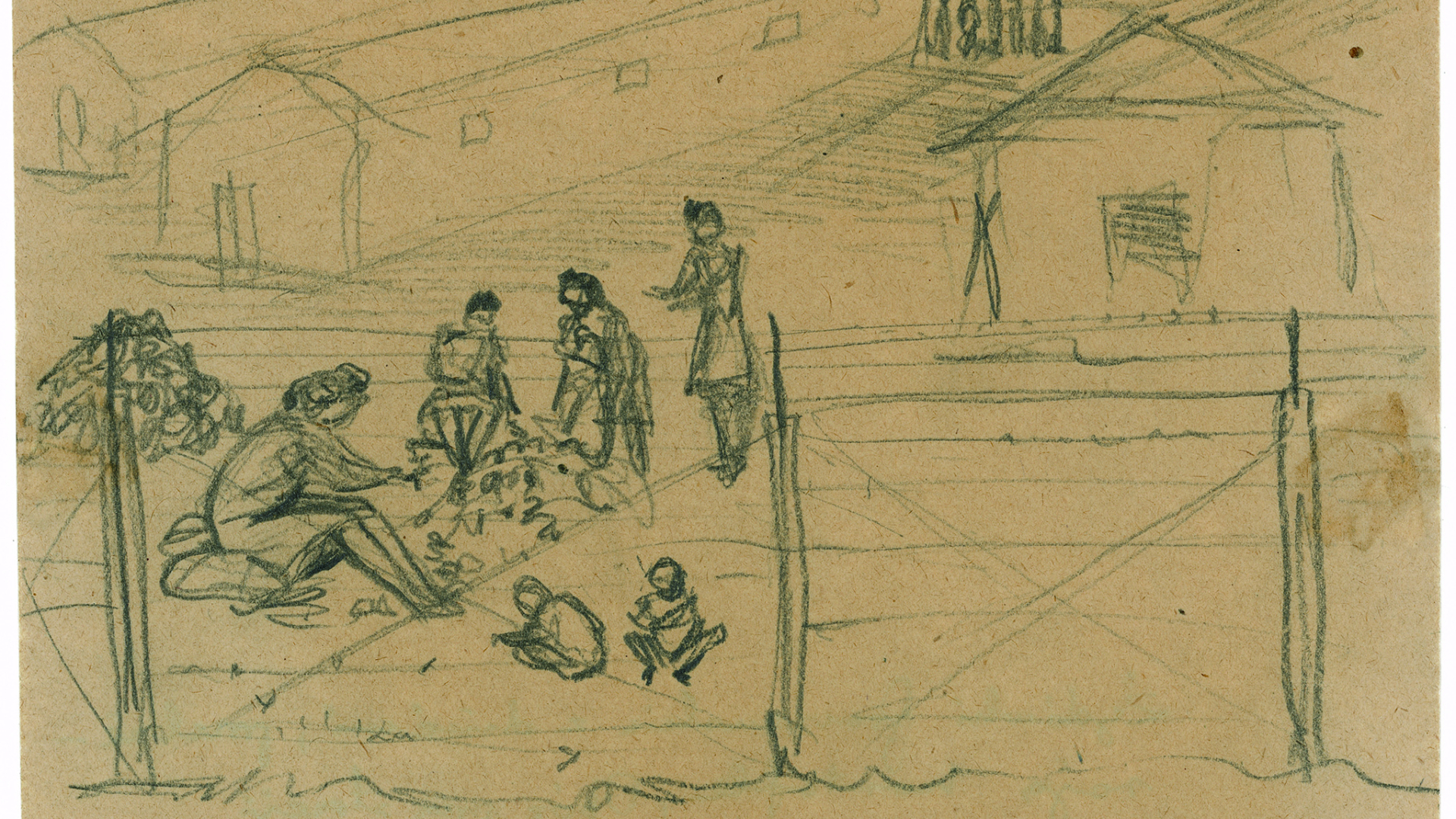
French Jewish women with children, sorting potatoes. I saw the camp by the station from the window. Transport to Sobibór, Trawniki, 1943.

Aryan Papers

Between the end of 1942 and the beginning of 1944, Paszko and his wife helped Rychter. According to the account, they had met before the outbreak of the war and had also served in the army together, which suggests they must have been of a similar age. However, a search of the Central Military Archives yielded no new information. In his account, Paszko mentions that Richter came from the Chełm area, but unfortunately does not specify a particular town. It has in fact proved impossible to establish the artist’s place and date of birth.

Paszko describes his charge in the following words: “He was a very pleasant man, with whom I became close over a long period of time.” From the outset, he was aware of the reason why Richter had come to him. Having served as a soldier in the Peasant Battalions during the war, he arranged for the fugitive to obtain ‘Aryan papers’ in the name of Zbigniew Zaprzalski. Leonarda Paszko also played an important role – her husband recounted: “He used to borrow clothes from us, and that was all down to my wife, who looked after his clothes and his underwear.”

His new identity, combined with his good looks and knowledge of Polish, may have led Richter to enlist in the Baudienst. Paszko wrote the following about his charge: “Józef Rychter worked on the railways in labour brigades, depending on the districts to which he was sent. He was in Trawniki, Krasnystaw and Piaski. Most recently, he worked in Sobibór. […] He worked as a Pole […] and would pop in to see me from time to time.” Rychter was both a witness to and a chronicler of the Holocaust suffered by his fellow Poles, and he would sketch the scenes he observed on scraps of paper, a fact also confirmed by Paszko’s account: “He drew documentary sketches on whatever he had to hand. If he had paper, he drew on paper; if he had a newspaper, he drew on the newspaper.” According to the Pole’s account, he was a trained painter, which explains his skilful brushwork. Meanwhile, among the materials found by Professor Dariusz Libionka at the Ghetto Fighters’ Museum, there is a handwritten note suggesting that Richter was a professional photographer. He produced his final sketches in Sobibór.

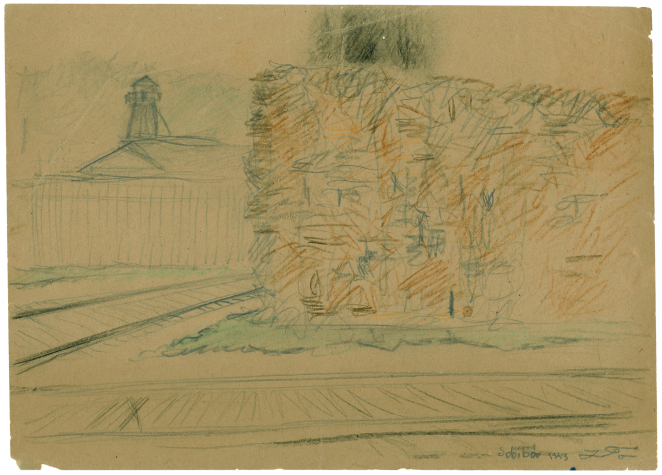
Sobibór. A high wall woven from dried pine needles conceals the gas chambers. The sidings run behind the wall; only half a train can fit behind it, so the transports have to be split into two parts. Unloading time: 20 minutes. Sobibór, 1943.

Whenever Richter visited the Paszkos’ home, he would leave his drawings with them for safekeeping. Paszko had them with him during his stay in Israel. At this point, it is worth mentioning Miriam Nowicz, who works at the Museum of Ghetto Fighters, as she presented a different account of how the drawings were obtained, offering, in fact, two versions. According to the first account, during her stay in Poland she met an anonymous Polish man living near Chełm, who gave her Richter’s sketches. Could this have been Paszko? We do not know. However, in the catalogue she compiled for an exhibition of Richter’s works, published in 1974 in Israel, she stated that the drawings had been handed over by the family of Max Grodus. Who Grodus was and how he came into possession of them has not yet been established. The fact is that the Ghetto Fighters’ Museum’s collection contains 18 sketches.

Survival Strategy

Richter adopted a different tactic to that of many Jews seeking refuge, who regarded shelters, dugouts, cellars, attics and the like as safe places. His strategy for survival was to blend in with the Polish population, which was, however, a rather risky move and probably led ultimately to his death. According to the account, after losing contact with Richter, Paszko tried to track him down. He visited places where his charge had previously been, but all trace of him had vanished: “We made enquiries at his places of work. Some said he had died of typhus, whilst others said he had been recognised from sketches. However, these are merely hypotheses and conjectures; there is no concrete evidence. And as he did not return to me in 1944, he is probably dead.” Nowicz’s interviewee reported that the artist had joined a partisan unit and was killed in a skirmish. It is also highly likely that no one from Richter’s family survived the war.

Undoubtedly, Paszko’s account sheds new light on this talented artist, whose works stand as a unique testimony to the Holocaust. Nevertheless, many questions remain: where and when was Richter born? What happened to him during the occupation? Did he survive the war, and if not, under what circumstances did he die? Perhaps, as in the case of Paszka’s account, the most important factor determining further research will simply turn out to be chance.

Suspect Element

During the occupation, the fate of this talented artist became intertwined with that of a Polish family, whose story also deserves closer examination. In the early 1960s, Paszko joined the ORMO, from which he was expelled a year and a half later. A note drawn up by the commander of the MO in Piaski indicates that he was involved in the activities of the church choir, and that his membership of the organisation did nothing to improve the functioning of that group. It can therefore be assumed that, in the eyes of the communist authorities, he was an ‘unreliable element’.
The Paszkos never received the Righteous Among the Nations medal. This may have been due, on the one hand, to a lack of contact after the war with the Jews who had survived the war thanks to their support, and, on the other hand, to Richter’s death.

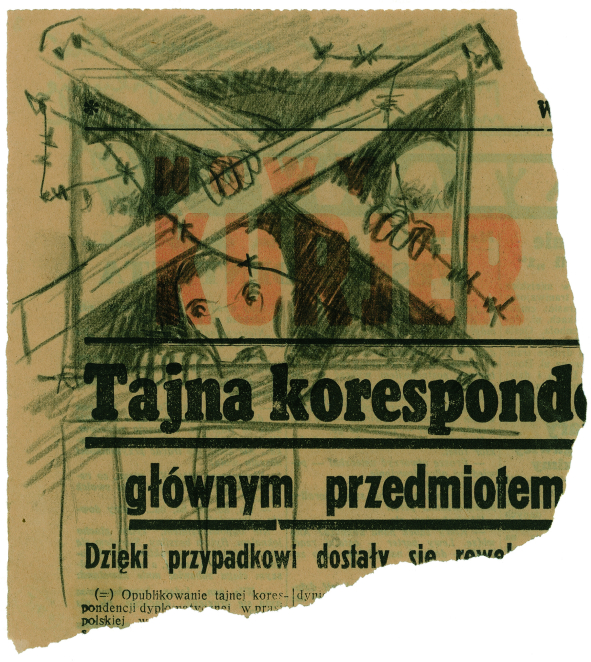
A window in the carriage. They’re asking for water. The guards are keeping watch; we’re sitting on the train on the other platform. I’m quietly drawing on a newspaper.