Functionary Prisoners

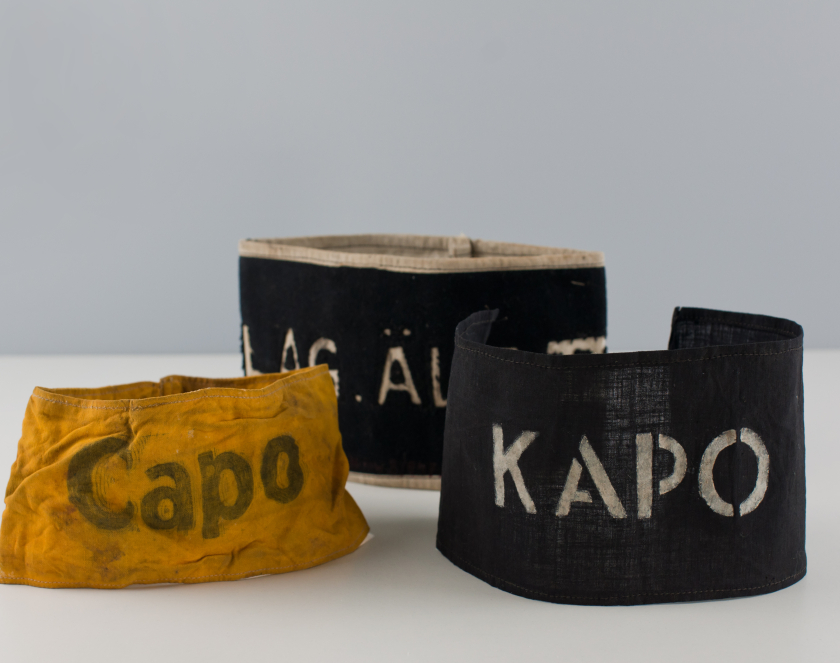
Three fabric armbands with the inscriptions Kapo, Capo, and Lag. Alt.
Functionary prisoners held important positions in the structural organisation of every concentration camp. In exchange for helping the SS with supervising the masses of prisoners, they could count on various profits and conveniences. In practice it was the attitude of the functionaries – in particular their degree of cooperating with the SS and the way they treated other prisoners – that highly influenced the degree of terror in he camp.

Functions

The supervision of all prisoner fields was the duty of a camp elder (Lagerältester), who ruled over the team of block elders and stubendienst, who oversaw particular barracks and were responsible for the distribution of food. Lagerkapo, on the other hand, exerted control over labour organisation in every field. He did it through his subordinates – kapos and their helpers called vorarbeiters. The privileged prisoners distinguished themselves through clothes, armbands with their function names, often also with whips which serves as an attribute of their power.

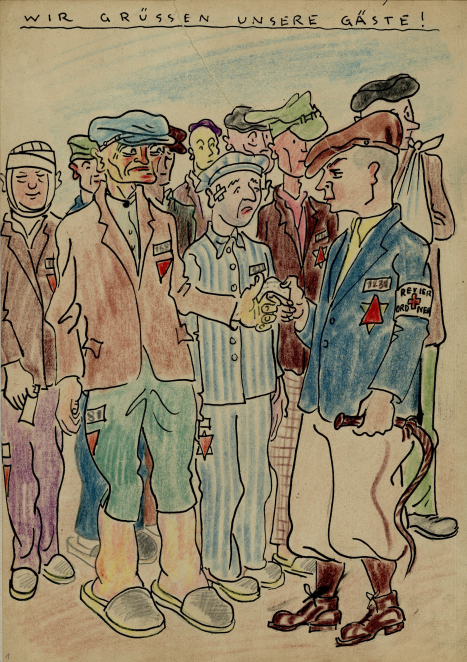
The drawing shows a group of people with prisoner numbers and red triangles on their clothes. The man in front is holding a whip. Above them is an inscription in German: “Wir grüßen unsere Gäste” (We greet our guests).
A drawing created in the camp by a Slovak Jew. It represents a functionary with a group of prisoners. The words “WIR GRÜSSEN UNSERE GÄSTE!" [WE WELCOME OUR GUESTS] alludes to the brutality of kapos towards the recently admitted inmates.

Attitude Towards Other Inmates

The functionaries were generally not well remembered by survivors. Testimonies usually contained descriptions of their convenient and privileged positions, brutal treatment and frequently even murder of other prisoners. Functionaries were a tool in the hands of the camp SS authorities, who attempted to inspire divisions and antagonise the prisoners. One such measure was granting power to people of ethnicity that was different than the prisoners they ruled over. The overall evaluation of functionaries, however, is not unequivocal. Besides the really prominent figures (mostly Germans) there were numerous low-rank helpers. Not all of them were sadists and murderers. Some functionaries refrained from violence, helped other inmates, and even worked in the camp resistance movement. Nonetheless, they were all – to some extent – privileged over the remaining prisoners of Majdanek.

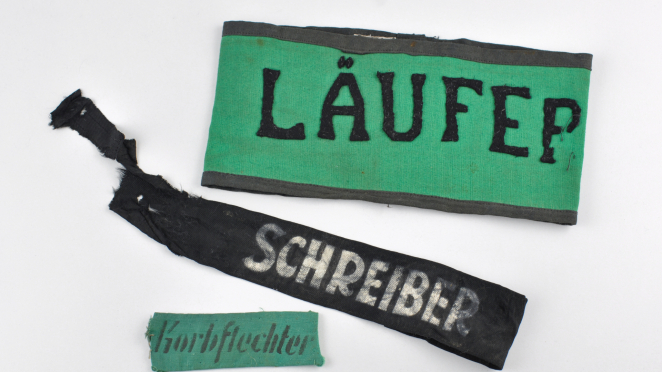
Photo of three fabric armbands.
Armbands worn by functionary prisoners: Läufer (runner), Schreiber (writer/clerk) and Korbflechter (basket maker).
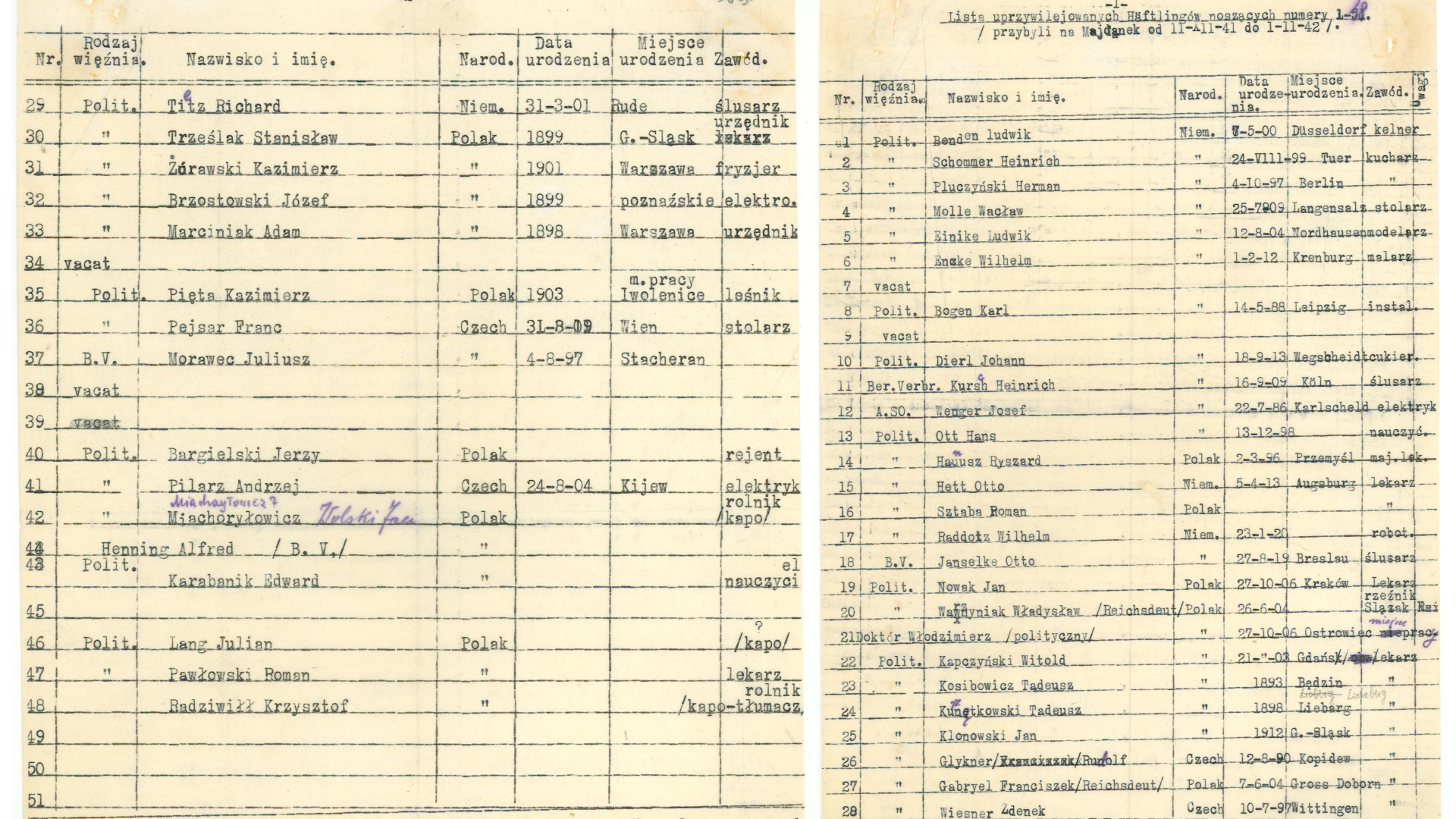
Two documents in Polish, with the data presented in tabular form: no., surname and first name, nationality, date of birth, place of birth, occupation.
The list of privileged prisoners of Majdanek, registered at numbers between 1 and 48 and deported to Lublin in late 1941. Most of them were German criminals and Polish physicians. The list was compiled by the in-camp resistance.